A Police Positive
Neil had a Colt Trooper MKIII on his shelf again. I guess the owner of that gun is just paying the interest on it over and over. He had a couple of black tactical pistols as well.
Dave had a Taurus Model 65 for $159 along with his Rossi 971. Nothing much had moved in his cases.
Amber had a Beretta 96 Brigadier for $359.
One day, while in a hole in the wall pawn shop, I spied what I thought was an early Detective Special. It looked rather lonely in it's fake stag Franzanite grips, so I asked to see it.
What was handed to me was even more interesting.
 I was handed a First Generation Colt Police Positive. As serial number 1529XX, it came out of the Colt factory late in 1923. All the numbers matched, and it locked up with the famed Colt tightness. What was interesting was the barrel. It had been cut down to two inches and had the original sight silver soldered back on. As I held the gun, I felt the history flow out of it. I felt more history in this gun than any sock drawer special collector gun I have held. The gun was altered and as such had no real collector's value. I'm interested in the history of concealed carry though, not the history of firearms manufacture. We dickered a bit and agreed on a price.
To me, this gun had value.
Because of the quality of the work, and the use of the original sight, I made the leap of faith that the attenuation of the barrel occured early in this Colt's life. At one time somebody needed effective concealed protection. Either it wasn't available from the factory or in the township, or money was not available. The owner of this gun decided to take matters into his own hands and delivered it to a skilled gunsmith. The revolver was delivered back to the owner as an effective carry weapon. I am drawing this conclusion based on the availability of weapons and the economic reality of the time, but I believe the barrel was cut down either before or during the Great Depression. Because of the remaining blue finish, I believe this gun was stored for several decades before it came into my posession. An interesting aside is that it fits perfectly into my J frame pocket holsters.
I was at first confused that on a weapon such as this, the hammer had not been bobbed. I learned from my patients that in the 1920's there were many people who had learned to shoot with the Colt SAA. Cocking a hammer on a draw was commonplace. On this gun, the thumb would likely have rested on the hammer while the gun was still pocketed, effectively shrouding it on the draw stroke. The unbobbed hammer supported my conclusion of when the barrel was cut down.
More pics can be found here.
Dave had a Taurus Model 65 for $159 along with his Rossi 971. Nothing much had moved in his cases.
Amber had a Beretta 96 Brigadier for $359.
One day, while in a hole in the wall pawn shop, I spied what I thought was an early Detective Special. It looked rather lonely in it's fake stag Franzanite grips, so I asked to see it.
What was handed to me was even more interesting.
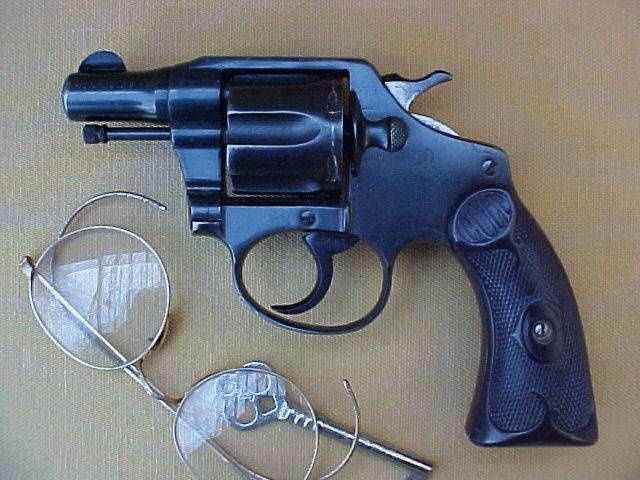 I was handed a First Generation Colt Police Positive. As serial number 1529XX, it came out of the Colt factory late in 1923. All the numbers matched, and it locked up with the famed Colt tightness. What was interesting was the barrel. It had been cut down to two inches and had the original sight silver soldered back on. As I held the gun, I felt the history flow out of it. I felt more history in this gun than any sock drawer special collector gun I have held. The gun was altered and as such had no real collector's value. I'm interested in the history of concealed carry though, not the history of firearms manufacture. We dickered a bit and agreed on a price.
To me, this gun had value.
Because of the quality of the work, and the use of the original sight, I made the leap of faith that the attenuation of the barrel occured early in this Colt's life. At one time somebody needed effective concealed protection. Either it wasn't available from the factory or in the township, or money was not available. The owner of this gun decided to take matters into his own hands and delivered it to a skilled gunsmith. The revolver was delivered back to the owner as an effective carry weapon. I am drawing this conclusion based on the availability of weapons and the economic reality of the time, but I believe the barrel was cut down either before or during the Great Depression. Because of the remaining blue finish, I believe this gun was stored for several decades before it came into my posession. An interesting aside is that it fits perfectly into my J frame pocket holsters.
I was at first confused that on a weapon such as this, the hammer had not been bobbed. I learned from my patients that in the 1920's there were many people who had learned to shoot with the Colt SAA. Cocking a hammer on a draw was commonplace. On this gun, the thumb would likely have rested on the hammer while the gun was still pocketed, effectively shrouding it on the draw stroke. The unbobbed hammer supported my conclusion of when the barrel was cut down.
More pics can be found here.
posted by Xavier at 11:41 AM


0 Comments:
Post a Comment
<< Home